
Why I Stopped Checking Email After 8 PM

Last month, I caught myself nodding along to my daughter's excited story about her art project while secretly scrolling through work emails under the dinner table. She stopped mid-sentence, looked directly at me, and asked, "Dad, are you actually here?"
That moment changed everything I thought I knew about productivity.
We've been sold a lie about being "always available." The hustle culture promises that responding to emails at midnight makes us indispensable, that checking Slack on weekends proves our dedication, that being perpetually "on" is the path to career success.
But here's what 15+ years across consumer goods, banking, and technology taught me: The most successful professionals I know have mastered something most people never learn—the art of strategic disconnection.
If you want weekly insights that actually move your career forward without burning out your relationships, you're in the right place.
The hidden cost destroying mid-career professionals
I spent years wearing my 24/7 availability like a badge of honor. Midnight emails, weekend Slack responses, "quick" work messages during family dinners—I thought this made me valuable.
The research tells a different story.
Harvard Business Review's meta-analysis of 40+ studies revealed something startling: Employees with clear digital boundaries reported 23% higher job satisfaction and 19% better performance reviews compared to their always-available counterparts.
But the real cost isn't just professional—it's deeply personal.
Chronic stress from constant connectivity keeps your nervous system in perpetual fight-or-flight mode. Your cortisol levels stay elevated, leading to poor sleep, impaired decision-making, and that exhausted feeling that no amount of coffee can fix.
Fragmented attention means you're never fully present anywhere. Not at work, where every notification breaks your deep focus. Not at home, where you're physically there but mentally trapped in your inbox.
Relationship erosion happens gradually, then suddenly. Those half-listened conversations with your kids, distracted dinners with your partner, missed moments that you can't get back.
I realized I was modeling the exact opposite of what I wanted my children to learn about work-life integration.
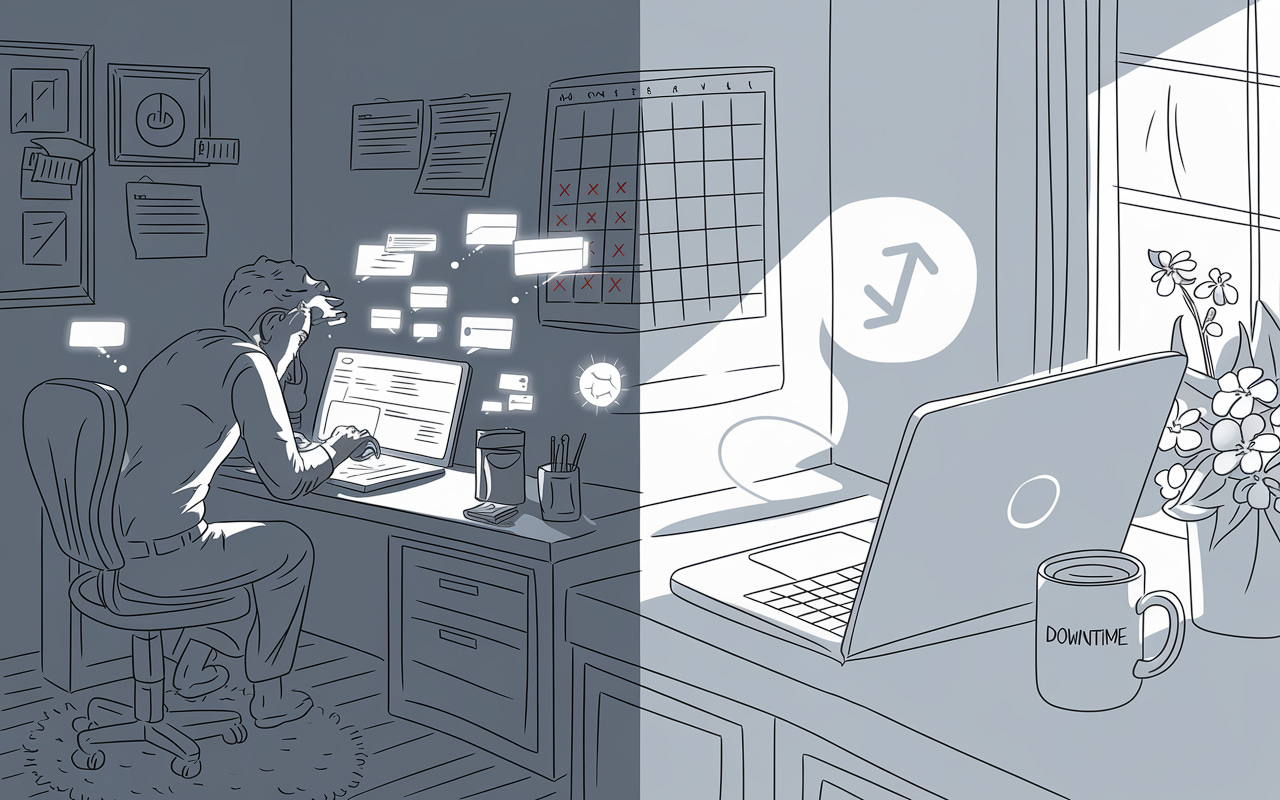
What France figured out (and why it's spreading globally)
In 2017, France implemented something revolutionary: the legal "right to disconnect." Companies with 50+ employees must establish clear policies preventing after-hours digital communication.
The results? Employee stress decreased by 32%, sick days dropped by 18%, and productivity actually increased by 13%.
This isn't just European idealism—it's spreading because it works.
Volkswagen automatically shuts down email servers 30 minutes after shifts end. Daimler implemented "Mail on Holiday," which auto-deletes emails sent to vacationing employees (with an auto-reply offering alternative contacts for urgent matters).
Microsoft Japan tested a four-day work week with digital boundaries and saw productivity jump 40%.
The pattern is clear: Well-rested minds are productive minds.
But here's what most articles about work-life balance miss—this isn't just about policies. It's about leadership courage.
The three-layer transformation that actually works
After consulting with executives across eight industries, I've identified three critical layers that must align for sustainable change:
Personal boundary mastery
Choose your endpoint and guard it ruthlessly. Mine is 8 PM. Not 8:15, not "just this one email"—8 PM.
Recognize the anxiety spiral that whispers, "What if I miss something critical?" Ask yourself: "In my entire career, how many true emergencies happened after hours?" For most professionals, it's fewer than you think.
Communicate your boundaries proactively. I tell my team: "I'm available until 8 PM for urgent matters. If it's truly an emergency, call my phone. Otherwise, I'll address it first thing tomorrow with fresh perspective."
Team culture evolution
Establish "focus hours" where no meetings are scheduled and messaging is discouraged. My team reserves 2-4 PM for deep work—no Slack, no calls, no interruptions.
Redefine emergency protocols. We created a simple test: "Will this cost us money or reputation if delayed 12 hours?" If not, it waits until business hours.
Celebrate boundary respect. When someone logs off at their designated time, acknowledge it positively. "Smart move getting offline to recharge" beats the old "dedication theater" of who can stay latest.
Organizational policy alignment
Measure outcomes, not online hours. Performance reviews should focus on results delivered, problems solved, and value created—not emails sent at midnight.
Implement technology buffers. Delayed send features, automatic "quiet hours" settings, and clear emergency contact protocols remove the pressure to be constantly available.
Lead from the top. When executives model healthy boundaries, everyone else feels permission to follow suit.
My 30-day experiment that changed everything
Three months ago, I committed to a radical experiment: Complete digital disconnection from 8 PM to 8 AM, every single day.
Week 1: Pure anxiety. Every instinct screamed that my career was ending because I wasn't responding to that 10 PM email from a colleague in another timezone.
Week 2: Sleep improved dramatically. I started waking up naturally, without the jarring anxiety of checking my phone immediately.
Week 3: Creative breakthrough. Solutions to problems I'd been wrestling with for weeks suddenly appeared during evening walks and weekend conversations.
Week 4: Professional confidence surge. I realized that my thoughtful, well-rested responses were far more valuable than my previous reactive, tired replies.
The result? My performance review three months later was the best of my career.
More importantly, my daughter now tells me her stories knowing I'm actually listening.
What this means for your career
The professionals advancing fastest in 2025 aren't the ones burning out—they're the ones who've mastered sustainable high performance.
Strategic disconnection isn't about working less—it's about working with intention.
When you protect your rest, you show up to important decisions with clarity instead of exhaustion. When you're fully present in meetings, people notice. When you respond thoughtfully rather than reactively, you build reputation for wisdom.
The hidden advantage: While your constantly-connected colleagues are experiencing decision fatigue and creative burnout, you're arriving each morning with renewed energy and fresh perspective.
This is particularly crucial for mid-career professionals. The "always on" approach might have worked in your twenties when you had fewer responsibilities. But now, with family obligations, aging parents, and complex professional challenges, sustainable performance becomes your competitive edge.
Your next move (start tonight)
Tonight's experiment: Choose one evening this week—just one—to turn off work notifications one hour earlier than usual.
Before you log off:
Write tomorrow's three priority tasks
Set an out-of-office message explaining your quiet hours
Tell one family member about your experiment
During your offline time: Pay attention to how your mind shifts. Notice the quality of your conversations, your sleep, and the thoughts that emerge when you're not constantly consuming information.
Tomorrow morning: Observe how you feel approaching work after genuine rest. Notice if solutions appear that weren't there yesterday.
Track the impact: After one week, evaluate your energy, creativity, and relationship quality. If the results surprise you, consider making it permanent.
Advanced move: If you manage others, propose a team "quiet hours" trial. Frame it as a performance experiment, not a benefit. Measure results after 30 days.
Community Engagement Question
What's been your biggest challenge in disconnecting from work? Is it fear of missing out, pressure from colleagues, or your own perfectionist tendencies?
And more importantly—what's one small boundary you're willing to try this week?
Join 3,000+ professionals who get weekly career insights that actually work. No generic advice about "finding your passion"—just the practical strategies successful people use but rarely share.
Every week, I break down real career challenges with solutions you can implement immediately. From executive presence to strategic career moves, we cover what actually matters for mid-career advancement.
